
31st Kagyu Monlam
January 3, 2014
Subevents
བོད་སྐད་
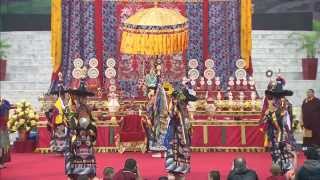
His Holiness Karmapa Performs the Tsechu Cham.
10th Jan, 2014. The tenth and twenty-fifth days of the lunar month are significant times for practice. The outer reason is that according to tantric teachings, on these dates, the heroes and yoginis from the twenty four sacred sites naturally gather to bless the yogi. The inner reason is that the meditator's subtle channels, winds, and essence drops naturally gather around the central channel on these dates, so they are a superior time for meditation. The secret reason is that if a yogi performs a puja with the particular samadhi of the secret mantra, there is especially great merit. Another reason why the tenth day is significant is its association with Guru Padmasambhava. Many in Tibet consider that Padmasambhava was extraordinarily kind to the Snow Land of Tibet. He himself said that in the future he will actually come on the tenth day of every lunar month to bless his followers. The History of the Tsechu Puja The Tsechu Lama dance arose 800 years ago from the pure visions of Guru Chöwang. There are long and short versions. The long is called the black hat dance, and the short the white horse dance. According to historical sources, this practice first came into the Kamtsang lineage at the time of the Eighth Situ Panchen Chökyi Jungne, who instituted it at Palpung monastery. Later during the time of the Fourteenth Karmapa Tekchok Dorje, it was introduced at Tsurphu Monastery, one of the seats of the Karmapa lineage. Situ Chökyi Jungne had learned the dance at Bentsang Monastery in Netong, so the present tradition is a continuation of the Netong tradition. In 1959, the Sixteenth Karmapa Rangjung Rigpe Dorje escaped to India, where he instituted the tradition of the Tsechu lama dance at Rumtek monastery, his seat in exile. Since then it has been preserved there in its entirety as a living tradition. The Nature of the Lama Dance This sacred lama dance with its long history and profound meaning is not like any ordinary dance one might perform. The essence or nature of the dance is recognizing that the nature of all phenomena is the union of appearance and emptiness. One's body, speech, and mind no longer remain ordinary, and one visualizes oneself as the form of the deity. The dance becomes a way to express this to other people. The Purpose of the Dance When a powerful yogi performs the lama dance, he can directly affect the body, speech, and mind of the viewers. All sentient beings have buddha nature, but it is hidden by obscurations. The lama dance is a way to purify these obscurations. Through the samadhi of the three vajras, the expressions of the body, speech, and mind of the deity purify the dancer's mental continuum. If the spectators, imagining and meditating on themselves as the deity, are also able to view it not as ordinary experience but as an expression of the deity, they will receive the blessings of the wisdom deities—it is no different than if the deities themselves actually came. Seeing the dance implants the seed of liberation within the viewer's being. According to the Hevajra tantra, the dance eliminates the outer and inner obstacles of the dancers themselves as well as those of the spectators. The dancer gains influence over the world because all that appears and exists is sealed with the stamp of the deity. It is also said that one will easily accomplish the recitation of the deity's mantra.
His Eminence Goshir Gyaltsab Rinpoche - Dharma Teaching ( Tibetan Only )
His Eminence Goshir Gyaltsab Rinpoche offered a spontenous dharma teaching, during the Kagyu Monlam, taking place in Bodhgaya India.
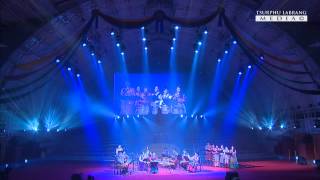
Marme Monlam
བོད་སྐད་ / English
Gyalwang Karmapa's teaching on The Torch of Certainty: Session Two - Jan 3rd, 2014.
The 17th Gyalwang Karmapa, Ogyen Trinley Dorje offered a 2 day teaching on the special mahamudra preliminary practices, Ngondro based on the text composed by the 1st Jamgon Kongtrul Rinpoche, Lodro Thaye, entitled "The Torch of Certainty". The teaching was given during the last 2 days of the 31st annual Kagyu Monlam Chenmo in Bodhgaya, India.
Gyalwang Karmapa's teaching on The Torch of Certainty: Session One - Jan 3rd, 2014.
The 17th Gyalwang Karmapa, Ogyen Trinley Dorje offered a 2 day teaching on the special mahamudra preliminary practices, Ngondro based on the text composed by the 1st Jamgon Kongtrul Rinpoche, Lodro Thaye, entitled "The Torch of Certainty". The teaching was given during the last 2 days of the 31st annual Kagyu Monlam Chenmo in Bodhgaya, India.
Gyalwang Karmapa's teaching on The Torch of Certainty: Session Four - Jan 4th, 2014.
The 17th Gyalwang Karmapa, Ogyen Trinley Dorje offered a 2 day teaching on the special mahamudra preliminary practices, Ngondro based on the text composed by the 1st Jamgon Kongtrul Rinpoche, Lodro Thaye, entitled "The Torch of Certainty". The teaching was given during the last 2 days of the 31st annual Kagyu Monlam Chenmo in Bodhgaya, India.
Gyalwang Karmapa's teaching on The Torch of Certainty: Session Three - Jan 4th, 2014.
The 17th Gyalwang Karmapa, Ogyen Trinley Dorje offered a 2 day teaching on the special mahamudra preliminary practices, Ngondro based on the text composed by the 1st Jamgon Kongtrul Rinpoche, Lodro Thaye, entitled "The Torch of Certainty". The teaching was given during the last 2 days of the 31st annual Kagyu Monlam Chenmo in Bodhgaya, India.
His Holiness Karmapa's talk on the Seven Line Supplication to Guru Rinpoche
Gyalwang Karmapa's teaching on The Torch of Certainty: Session Five - Jan 6h, 2014.
The 17th Gyalwang Karmapa, Ogyen Trinley Dorje offered a 2 day teaching on the special mahamudra preliminary practices, Ngondro based on the text composed by the 1st Jamgon Kongtrul Rinpoche, Lodro Thaye, entitled "The Torch of Certainty". The teaching was given during the last 2 days of the 31st annual Kagyu Monlam Chenmo in Bodhgaya, India.
Eight Verses of Training the Mind - Eng, Part 1 of 2
Karmapa,Kagyu,Karma Kagyu,Tibetan Buddhism,Vajrayana (Religion),Bodhgaya,Kagyu Monlam,Meditation
Eight Verses of Training the Mind - Eng, Part 2 of 2
Karmapa,Kagyu,Karma Kagyu,Tibetan Buddhism,Vajrayana (Religion),Bodhgaya,Kagyu Monlam,Meditation
བོད་སྐད་ / 中文
第十七世大寶法王開示《大手印了義炬》之一 (2)
第十七世大寶法王 鄔金欽列多傑對《大手印了義炬》的兩天開示。此四不共加行之著作的作者為第一世蔣貢康楚羅卓泰耶。法王於印度菩提迦耶舉行的第三十屆噶舉大祈願法會中最後兩天給予這項開示。
第十七世大寶法王開示《大手印了義炬》之一 (1)
第十七世大寶法王 鄔金欽列多傑對《大手印了義炬》的兩天開示。此四不共加行之著作的作者為第一世蔣貢康楚羅卓泰耶。法王於印度菩提迦耶舉行的第三十屆噶舉大祈願法會中最後兩天給予這項開示。
第十七世大寶法王開示《大手印了義炬》之一 (4)
第十七世大寶法王 鄔金欽列多傑對《大手印了義炬》的兩天開示。此四不共加行之著作的作者為第一世蔣貢康楚羅卓泰耶。法王於印度菩提迦耶舉行的第三十屆噶舉大祈願法會中最後兩天給予這項開示。
第十七世大寶法王開示《大手印了義炬》之一 (3)
第十七世大寶法王 鄔金欽列多傑對《大手印了義炬》的兩天開示。此四不共加行之著作的作者為第一世蔣貢康楚羅卓泰耶。法王於印度菩提迦耶舉行的第三十屆噶舉大祈願法會中最後兩天給予這項開示。
大寶法王噶瑪巴《蓮師七句祈請文》開示
第十七世大寶法王開示《大手印了義炬》之一 (5)
第十七世大寶法王 鄔金欽列多傑對《大手印了義炬》的兩天開示。此四不共加行之著作的作者為第一世蔣貢康楚羅卓泰耶。法王於印度菩提迦耶舉行的第三十屆噶舉大祈願法會中最後兩天給予這項開示。
《修心八頌》偈文
《修心八頌》偈文
His Eminence Goshir Gyaltsab Rinpoche - Dharma Teaching ( English Translation )
His Eminence Goshir Gyaltsab Rinpoche offered a spontenous dharma teaching, during the Kagyu Monlam, taking place in Bodhgaya India.
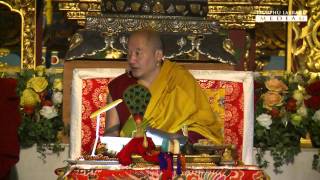
尊勝的國師嘉察仁波切於印度菩提迦耶第31屆噶舉大祈願法會給予說法開示
尊勝的國師嘉察仁波切於印度菩提迦耶第31屆噶舉大祈願法會給予說法開示